My Amyloid Story
Christine Giosa
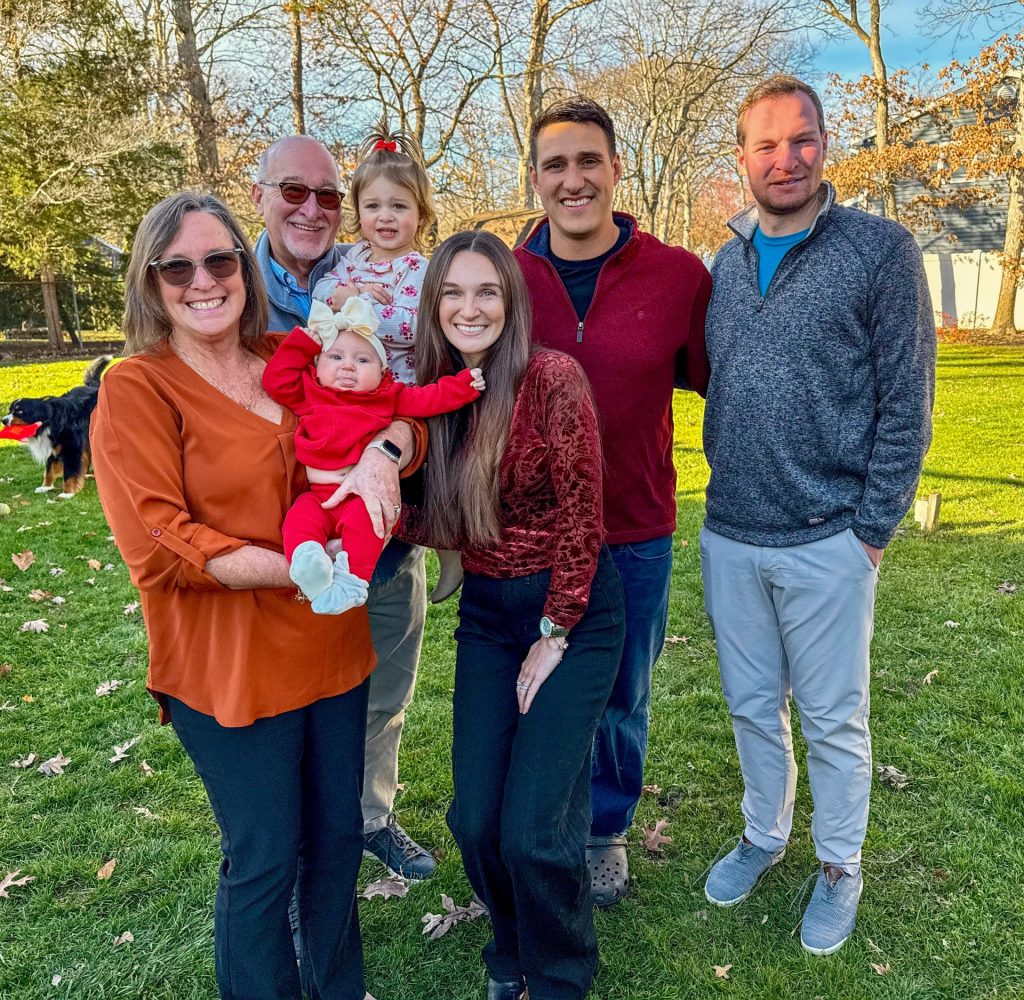
Hello! My name is Christine. I’ve been married to my wonderful husband for 35 years, and we have two children, ages 33 and 31, who have not been tested. I’m a proud Nonna to two beautiful granddaughters. I have one sister and two brothers.
I grew up in Wantagh, played sports throughout high school and into adulthood, and even coached volleyball. We were the Wantagh Warriors, and I was always proud to be a Warrior—though I never imagined I’d become one again in a very different way.
Today, I work as a bookkeeper for my husband, officiate volleyball for NYS, and watch our granddaughters.
My Amyloid Story Begins
My mom’s journey with amyloidosis began on April 14, 2016. She hadn’t been feeling well but tried to hide it, as she often did. After her primary care doctor noticed a change in her EKG, she finally told us something was wrong. When I checked her blood pressure at home, I saw the A-Fib indicator on the machine. We quickly got her in to see a cardiologist, and her echocardiogram showed “cardiac amyloid and hypertensive heart disease.”
No one explained what amyloid meant. When I asked, I didn’t get answers, so I began researching “amyloid deposits.” It was a disease we had never heard of—until it changed everything.
I learned that Columbia Presbyterian in NYC was a Center of Excellence, so on June 6, 2016 instead of going to our local ER again, I drove my mom straight to Columbia’s emergency room. If no one else was going to help, I was bringing her to the people who could.
She spent a month in the hospital—TEEs, cardioversions, an ablation, CCU—and I was even asked to sign a DNR. I knew I couldn’t, I knew my mom’s wishes. Doctors didn’t think she’d come home, and if she did, they said she’d be coming home to die. But she was released on July 1, went to rehab, and finally came home on July 21.
We returned for follow-up and genetic testing. The result? Inconclusive. How could that be? Her echo suggested amyloid, yet we were told there wasn’t enough information to say yes or no. We were left in limbo. My own cardiologist, who didn’t know much about amyloidosis but wanted to help, began monitoring me yearly with echocardiograms.
Fast-forward to 2019: my mom was still alive—she hadn’t come home to die. She was a Warrior, too. A new cardiologist recommended she be tested again because a medication was now available, but only with a positive genetic result. She was retested on February 21, 2019, and this time, she was positive.
I learned that three unrelated people are required to classify a new variant. Our variant began with my mom, a woman in the Czech Republic, and a gentleman identified during an autopsy in Italy. With a new cardiologist, Mom finally received the medication she needed—though she was placed on hospice at the same time.
My mom passed away on February 20, 2020. She had four extra years with her family and was able to see some of her grandchildren marry. She never met her 10 great-grandchildren. She wanted to live forever, but we knew the end was near. I signed the DNR four days before she died.
My Journey
After my mom tested positive, my siblings and I were able to be tested. My sister and I moved forward; my brothers did not. Our tests came back “inconclusive” on August 19, 2019—but we were told we were actually positive and had to wait for variant reclassification.
On June 10, 2020, after my mom had passed, I received my final positive result. My brothers then decided to be tested: my older brother went through my local genetic cardiologist, and my younger brother—after struggling in Florida—was finally tested with a kit my doctor arranged. Both tested negative.
My local genetic cardiologist ordered a PYP scan and referred me to an amyloid specialist on Long Island. The results were a grade 1, I was terrified. While I was at an appointment with a local amyloid cardiologist specialist’s office, he called Columbia’s amyloid team and said, “You need to see this patient.” I was accepted and began baseline testing in February 2020. They did their own PYP scan and said my original PYP was miss read, I was a grade 0. I had no amyloid deposits in my heart.
I couldn’t see the neurologist at Columbia due to insurance issues, but I joined their clinic and participated in two studies—one at UPenn (2022–2023) and one at Columbia (2022). I stayed on top of everything I could.
In May 2023, at Columbia’s neurology clinic, I mentioned that my finger had felt arthritic for two years and that my foot pain might be from a broken sesamoid bone. My neurologist ordered a full-limb EMG. Two weeks later, I saw the word “abnormal” in MyChart.
On May 30, 2023, my cardiologist called with the results. He knew it would crush me. I thought “abnormal” just meant closer monitoring. Instead, he said the words I had feared for seven years: “You need to start treatment now.”
I know they caught it early and I am extremely lucky, but I shut down for a few days. I told my sister, but couldn’t talk to anyone else. I had always told my mom it was okay to have a pity party—as long as you got back on the horse. Now it was my turn.
Becoming a Warrior Again
My team worked hard to get all my approvals. I was approved for Amvuttra and received my first treatment on June 29. I had believed the pain in my finger was arthritis, but X-rays were negative. Was it amyloid? Maybe. What I do know is that on July 21, 2023, I was able to twist open a bottle for the first time in two years, and the pain has slowly decreased.
The burning and tingling in my toes and the strange sensation of “spiders crawling” on my feet have also improved.
My first injection was nerve-wracking. The nurse said she would inject it in my stomach—not my arm as I expected. I didn’t have side effects, but I was exhausted. Whether from the injection or the stress, I don’t know.
After 2½ years, I’m still tired on treatment days, and I still battle insurance every three months for delivery—but I look forward to each treatment.
I have officially joined the group of Warriors fighting this disease.
Let’s win this fight—together.